Worm Gear Manufacturers: What Truly Defines Production Excellence
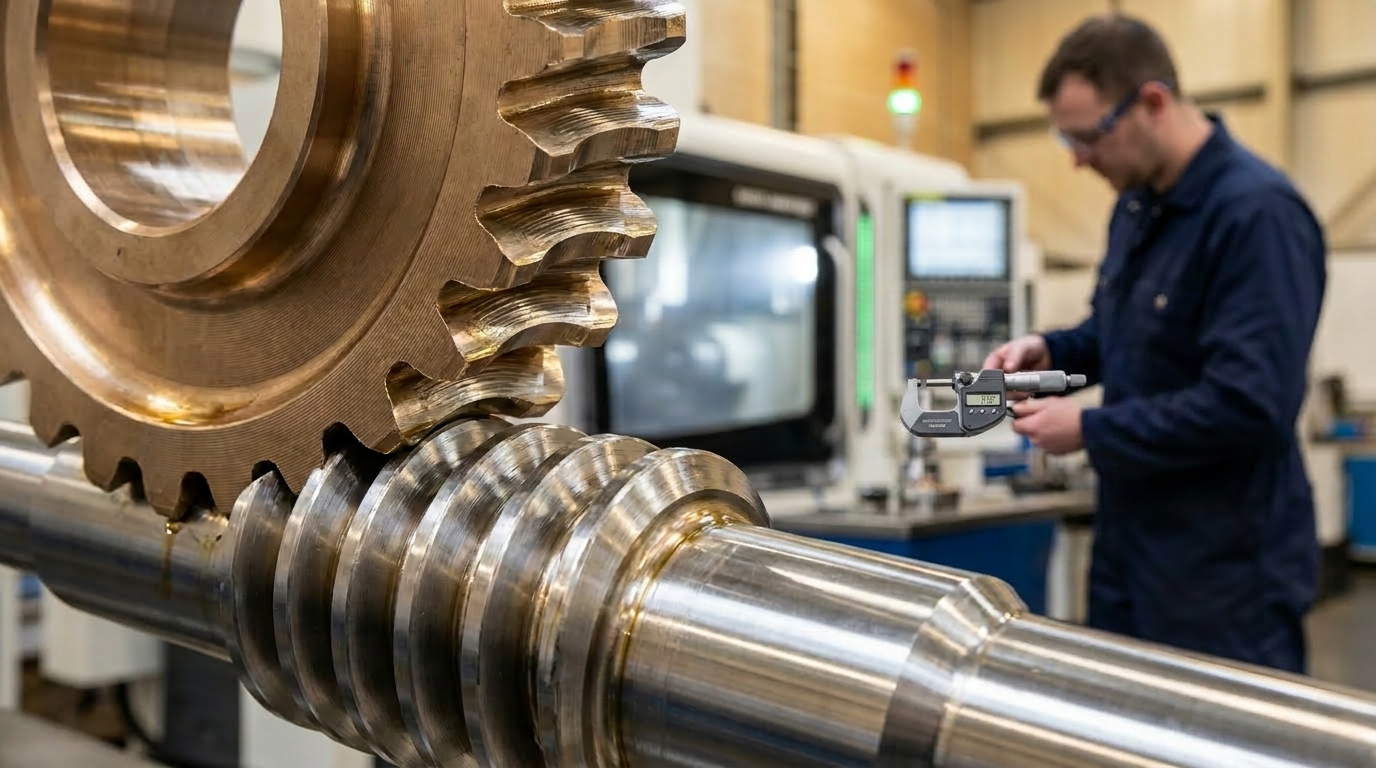
A worm gear set appears deceptively simple on an engineering drawing: a cylindrical screw engages a toothed wheel, reducing speed and multiplying torque in a quiet, compact package. But the difference between a gearbox that runs silently for a decade and one that seizes within months rarely shows up on a specification sheet. It lies embedded in the manufacturing decisions—material pairings, grinding tolerances, surface finishes, and inspection rigor—that worm gear manufacturers make long before a single part ships.
For factory owners, procurement engineers, and industrial operators, understanding these hidden differentiators is not an academic exercise. It determines whether a high-ratio drive delivers predictable performance, manageable heat, and controllable maintenance costs, or becomes a recurring bottleneck on the production floor. This article examines the manufacturing factors that separate consistent, quality-driven worm gear manufacturers from commodity suppliers, and what that means for anyone specifying or purchasing these critical transmission components.
Why Worm Gear Quality Is a Manufacturing Challenge
Worm gears operate under fundamentally different conditions than most other gear types. Where spur or helical gears roll across each other, worm and worm wheel mesh with significant sliding contact. This single characteristic reshapes every quality priority in the manufacturing chain.
Sliding contact generates friction, friction generates heat, and heat degrades lubrication. When the tooth surface is too rough, geometrically inconsistent, or poorly matched with its mating material, the resulting wear accelerates exponentially—often in applications where access for inspection is limited and downtime costs are severe. This is why leading worm gear manufacturers treat surface condition, not just dimensional accuracy, as the primary quality gate.
A worm gear set that meets nominal drawing dimensions can still fail prematurely if:
- The worm surface finish is not controlled for the lubrication regime
- The bronze wheel material is selected without reference to sliding speed and duty cycle
- Heat treatment introduces uncontrolled distortion that is never corrected downstream
- Backlash is adjusted at assembly but not validated for thermal expansion under load
The manufacturing route, therefore, must match the application’s real working conditions—not just fulfill a checklist of dimensional tolerances.
Manufacturing Routes: The Technical Trade-Offs
Not all worm gear sets are made the same way, and the production route chosen by worm gear manufacturers directly influences performance, longevity, and cost. The table below summarizes the most common industrial approaches.
| Manufacturing Route | Typical Application | Key Advantage | Primary Risk |
| Cut worm + hobbed wheel | Standard industrial reducers | Cost-effective, mature technology | Surface quality depends heavily on tool condition |
| Ground worm + cut wheel | Higher-speed or smoother-running drives | Superior worm accuracy and finish | Process cost increases |
| Hardened and ground worm + bronze wheel | Wear-critical, high-duty-cycle applications | Excellent durability and running behavior | Material compatibility and distortion control are essential |
| Precision-finished matched pair | Noise-sensitive or high-efficiency drives | Best mesh consistency | Requires tight process control and comprehensive inspection |
The critical insight here is that no single route serves every application. Elevator drives, conveyor gearboxes, packaging machinery, and heavy industrial agitators each impose different combinations of speed, load, start-stop frequency, and thermal environment. The most capable worm gear manufacturers guide customers toward the route that aligns with actual duty conditions rather than defaulting to the lowest quoted price.
Core Factors That Determine Worm Gear Quality
When evaluating potential worm gear manufacturers, buyers who understand the following five production pillars make better long-term decisions than those who compare only ratio, dimensions, and unit cost.
1. Material Pairing: The Foundation of Wear Resistance
Material selection for worm drives is fundamentally a tribological problem—a question of how two surfaces behave under sustained sliding contact. The conventional pairing of a hardened steel worm with a bronze worm wheel has endured for good reason: it balances the worm’s need for wear resistance and fatigue strength with the wheel’s need for conformability and embeddability.
However, not all “bronze” is interchangeable. Continuous-cast phosphor bronze, centrifugally cast tin bronze, and aluminum bronze each exhibit different hardness, friction characteristics, and load capacities. A qualified manufacturer specifies the exact grade based on sliding velocity, contact stress calculations, and expected oil temperature—not merely material availability or cost.
2. Tooth Generation and Grinding: Precision Beyond the Drawing
Modern CNC hobbing and thread grinding machines can achieve remarkably tight tolerances, but machine capability alone guarantees nothing. Tool wear, setup repeatability, and the relationship between worm geometry and wheel generation all influence final mesh quality.
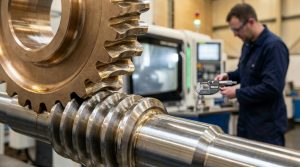
Grinding the worm after heat treatment addresses one of the most persistent quality problems in the industry: distortion. When a worm is hardened without subsequent finish grinding, micro-deformations of the tooth profile create irregular contact patterns that no amount of assembly adjustment can fully correct. Progressive worm gear manufacturers invest in grinding capacity precisely because it closes the loop between heat treatment and final geometry.
3. Heat Treatment: Hardness Without Distortion
Case-hardening, induction hardening, and nitriding all increase the worm’s surface durability, but each introduces different risks of dimensional shift. The key question for a manufacturer is not simply “what hardness can we achieve?” but “how do we maintain profile accuracy after hardening?”
Controlled atmosphere furnaces, precise quenching protocols, and immediate post-treatment inspection help ensure that hardness gains do not come at the expense of meshing quality. When evaluating worm gear manufacturers, evidence of heat treatment process control—including furnace logs and post-treatment dimensional verification—carries more weight than a hardness specification on paper.
4. Surface Finish: Where Efficiency Is Won or Lost
Surface roughness (Ra, Rz values) on the worm thread flanks directly affects friction coefficient, operating temperature, and the establishment of elastohydrodynamic lubrication films. A ground worm with Ra below 0.4 µm will typically run cooler and more efficiently than a cut-only worm with Ra above 0.8 µm, all other factors being equal.
This is not a cosmetic concern—it is a functional one. For every 10°C reduction in steady-state operating temperature, lubricant life can double. The surface finish standard therefore becomes an economic variable, influencing not only energy consumption but also oil change intervals and bearing life downstream.
5. Inspection Discipline: Beyond Go/No-Go Gauges
Inspection in worm gear production must extend beyond simple dimensional verification. Leading manufacturers perform:
- Contact pattern analysis using marking compound to visualize mesh contact under controlled load
- Lead and profile measurement on dedicated gear metrology equipment
- Surface roughness measurement on both worm and wheel tooth flanks
- Backlash verification across multiple positions to assess pitch consistency
- Runout testing to detect eccentricity introduced during assembly or machining
Without this depth of inspection, even a well-machined gear set carries hidden risks that only become apparent during operation—when correction is most expensive.
What Good Manufacturing Delivers
The payoff from disciplined worm gear production manifests in measurable operational improvements:
| Performance Metric | Improvement from Quality Manufacturing | Operational Impact |
| Running smoothness | Lower vibration and noise | Improved workplace environment, less structural fatigue |
| Transmission efficiency | Reductions in frictional losses of 2-5 percentage points | Lower energy cost, cooler running |
| Service life | 2-3× longer mean time between overhauls | Reduced maintenance spend, less unplanned downtime |
| Batch consistency | Variation in key parameters held within narrow bands | Predictable commissioning, fewer field adjustments |
| Failure root-cause clarity | Traceable process history | Faster diagnosis when issues arise |
These outcomes translate directly into total cost of ownership advantages that dwarf the initial purchase price advantage of less rigorously manufactured alternatives.
Selecting Among Worm Gear Manufacturers: Practical Guidance
For buyers and engineers tasked with sourcing worm gear components or assemblies, the following evaluation approach yields better results than a simple price-and-delivery comparison.
Probe the material decision. Ask not just “what material do you use?” but “what material pair do you recommend for this sliding speed and duty cycle, and why?” Manufacturers who answer with application-specific reasoning demonstrate genuine engineering capability.
Inquire about finishing procedures. How is surface finish achieved? What Ra values are typically held in production? How is finish verified? If these questions produce vague answers, the manufacturing discipline may not be in place.
Assess process stability, not just one sample. A carefully produced prototype proves little about routine batch quality. Request evidence of statistical process control—control charts, capability indices, or batch inspection records—that shows how quality is maintained over hundreds or thousands of units.
Confirm that lubrication enters the design conversation. The best worm gear manufacturers treat lubrication as an integral design parameter, specifying oil type, viscosity grade, and sump temperature targets during the engineering phase rather than leaving it as an afterthought for the installer.
Evaluate inspection scope. Understand what is actually measured on every part, what is sampled, and what is assumed. Dimensions alone are insufficient; contact quality and surface condition must be part of the release criteria.
A Visual Resource for Manufacturing Professionals
For a clear, practical demonstration of the production processes discussed in this article, the following video offers an excellent on-the-ground view of gear machining and finishing operations:
Watch: Complete worm gear manufacturing process step by step
This footage illustrates key stages including hobbing, grinding, and dimensional inspection, making the technical concepts discussed above tangible for operators, quality engineers, and procurement professionals alike.
Factory owners, maintenance supervisors, and metalworking practitioners seeking ongoing technical content will also find the Make like PRO YouTube channel a useful resource. The channel features hands-on demonstrations of machining, casting, and industrial assembly techniques relevant to gear production and broader manufacturing operations. Visit Make like PRO for practical shop-floor knowledge that complements the engineering principles outlined in this article.
Challenges and Limitations in Current Practice
Even well-established worm gear manufacturers face persistent challenges that buyers should recognize. The global supply chain for high-quality continuously cast bronze alloys has narrowed, creating lead-time and pricing pressure. Skilled gear grinding technicians remain in critically short supply across mature industrial economies, making process stability harder to maintain across shifts. And the growing use of synthetic and bio-based lubricants—often driven by environmental regulations—is forcing manufacturers to revisit material pairings validated decades ago for mineral oils.
These structural pressures mean that the gap between quality-focused manufacturers and price-focused commodity suppliers is likely to widen in the years ahead, not narrow.
Future Trends in Worm Gear Manufacturing
The trajectory of worm gear production points toward several developments that will increasingly differentiate advanced manufacturers:
In-process metrology and closed-loop correction—where gear grinding machines measure tooth geometry mid-cycle and adjust parameters automatically—will reduce dependence on operator skill and improve first-pass yield.
Digital surface modeling using laser-scanning techniques will allow manufacturers to characterize tooth contact behavior under simulated thermal and load conditions before any physical testing.
Advanced bronze alloys and surface coatings are extending the load and speed envelopes where worm drives remain competitive against alternative right-angle drive technologies, particularly in electric vehicle and renewable energy applications.
Integrated condition monitoring, where production quality data feeds into a digital thread that follows the gear set through installation and service, will help operators make better maintenance and replacement decisions.
Conclusion
The difference between worm gear manufacturers who consistently deliver reliable performance and those who merely produce parts that “will rotate” is not mysterious. It is visible in material selection rigor, grinding and finishing discipline, heat treatment control, and inspection depth. For industrial buyers and engineers, understanding these factors transforms procurement from a price comparison exercise into a genuine risk-management activity.
A worm gear set is not a commodity. It is a precision tribological system where manufacturing decisions directly determine field behavior, maintenance cost, and operational lifetime. The most successful projects start not with the cheapest quote but with the clearest alignment between application requirements and the production capabilities a manufacturer brings to the table.



Post Comment